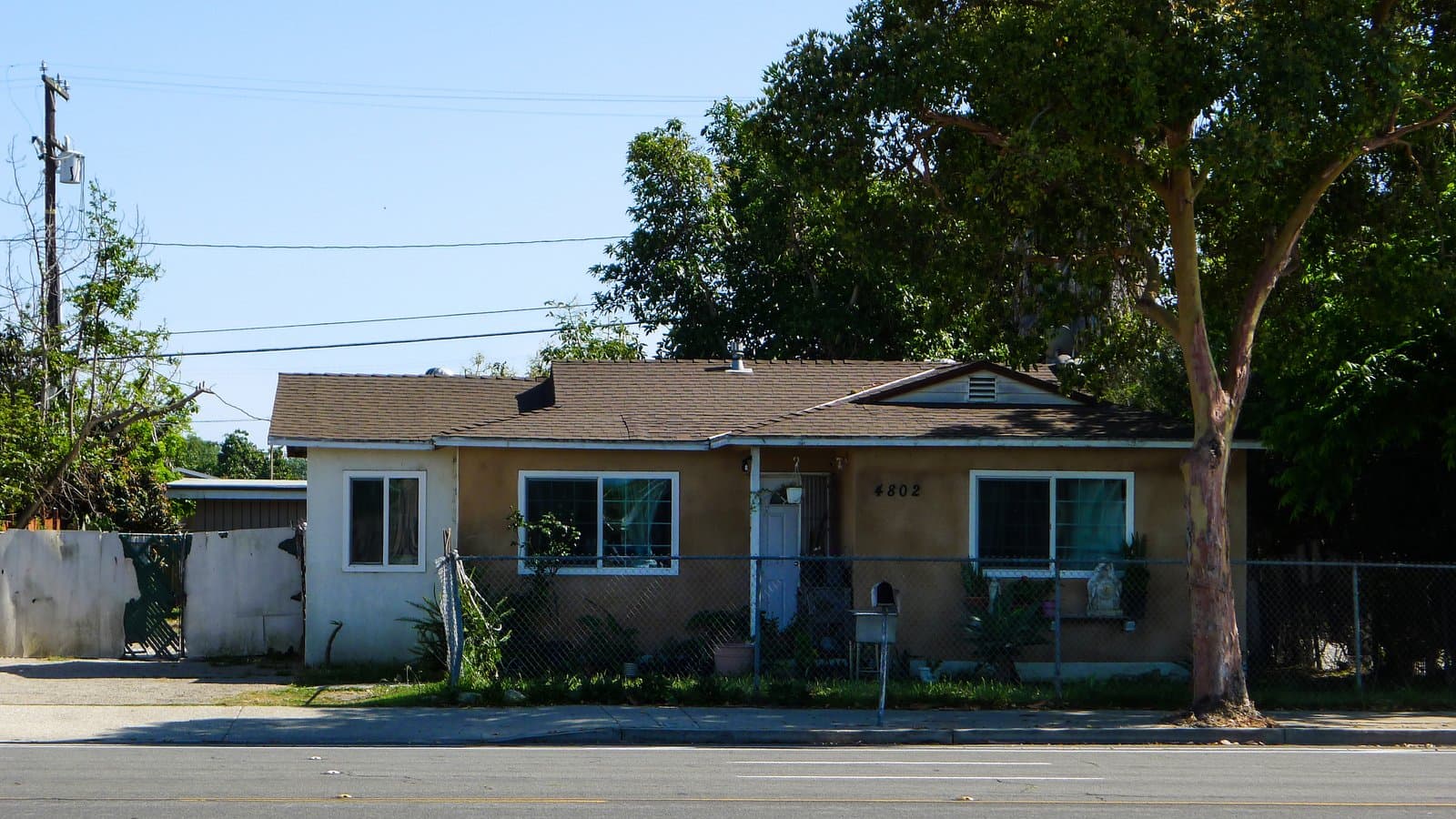
Orange County has run out of easy land. Master-planned tracts are built out, coastal sites are saturated, and the entitlement calendar on large greenfield parcels can stretch for years. What remains is the urban infill parcel: a small, well-located site that can deliver homes quickly in a market with deep unmet demand. 4802 W 1st Street in Santa Ana is exactly that kind of asset.
Why small sites are winning
Large-scale projects carry large-scale risk. They need heavy infrastructure, long approval cycles and substantial carrying costs before the first unit sells. A sub-one-acre infill site flips that equation. Utilities are typically already in the street, the surrounding grid is established, and the buyer pool is right next door.
For a regional builder, that translates into three practical advantages:
- Speed: shorter paths from closing to permits to vertical construction.
- Capital efficiency: less money is tied up in site work and holding costs before revenue begins.
- Demand proximity: buyers already live, work and shop in the surrounding neighborhoods.
What makes this corridor different
Central Orange County is a supply-constrained market. Entry-level and move-up homebuyers compete for a limited inventory of detached homes, and many are priced out of single-family product altogether. A well-designed for-sale townhome gives them ownership at a lower price point than a detached house, which is why townhome absorption has stayed resilient in dense urban submarkets.
The standalone lot at 4802 W 1st Street measures roughly 8,712 square feet (0.20 acres). On its own, that supports a compact project. Paired with the adjacent parcel at 4728 W 1st Street, the footprint grows to 18,092 square feet (0.415 acres), which is large enough to support a 14 to 20 unit townhome community.
The legislative tailwind
California has spent the past several years rewriting the rules for infill housing. Statutes such as SB 6, which opens the door to residential use on certain commercially zoned corridors, and the state density bonus program, which can add 20 to 50 percent more units, change the math for small commercial parcels. Sites that once looked like retail or office land can now be underwritten as housing sites. We will unpack each of these tools in the coming days.
The numbers at a glance
Based on the campaign's working underwriting, the opportunity looks like this:
- Combined land basis of roughly $1.7 million, or about $85,000 to $121,000 per door
- Projected gross sellout of $10.5 million to $15.2 million
- Projected developer profit in the range of $2.5 million to $5.0 million
These are projections built on stated assumptions, not guarantees, and every buyer should run its own diligence. But the spread between land basis and potential revenue is the reason experienced infill builders pay attention to parcels like this one.
Who should be looking
This opportunity is built for regional residential developers, infill builders, private equity partners seeking for-sale exposure, and brokers who represent them. If your pipeline needs a shovel-ready story in a high-demand corridor, this site deserves a spot on your short list.
Over the next 45 days, this series will walk through the site, the assemblage, the entitlement path, the financial model, the neighborhood and the transaction mechanics, one topic per day.
A word on timing
Infill opportunities rarely stay on the market for long, and the buyers who move first tend to shape the outcome. Early engagement lets a developer commission a feasibility study, meet with city staff and line up capital before competing groups finish their own screening. If you are building a pipeline for the next 24 to 36 months, the decisions made in the next few weeks matter. Use this series as a roadmap, and reach out to the listing team whenever a question needs a direct answer.
This content is for informational purposes only and is not legal, tax or investment advice. Projections are estimates and are not guaranteed. Listing brokerage: Century Financial Group.